

Back to Blog
maintenance
Why AC Coil Cleaning Is the Most Overlooked Maintenance Task in UAE Homes
26 April 2026
5 Min Read
Home Experts Team
Most UAE homeowners service their AC filters but completely ignore the coils — and it's costing them thousands in energy bills and early unit replacements. Here's everything you need to know about AC coil cleaning and why it matters more than you think.
Why AC Coil Cleaning Is the Most Overlooked Maintenance Task in UAE Homes
If you live in the UAE, your air conditioner is not a luxury — it is a lifeline. From April through October, indoor temperatures without cooling can reach dangerous levels. Most homeowners know to clean or replace their filters every few weeks, book an annual service, and call a technician when something sounds off. But there is one critical maintenance task that almost everyone misses: cleaning the AC coils.
This single oversight is responsible for skyrocketing electricity bills, poor cooling performance, and premature unit failure across thousands of UAE homes and offices every year. This guide covers everything you need to know — what coils are, why they get dirty, what happens when they do, and how professional coil cleaning can restore your unit to peak performance.
What Are AC Coils and What Do They Do?
Your air conditioning system has two sets of coils, and both are essential to the cooling cycle:
1. Evaporator Coils (Indoor Unit)
The evaporator coil sits inside your indoor air handling unit. Warm air from your room is drawn across this coil, which contains refrigerant at a very low temperature. The refrigerant absorbs the heat from the air, cooling it before it is blown back into your room. The moisture in the warm air also condenses on the coil surface, which is how your AC dehumidifies the room.
2. Condenser Coils (Outdoor Unit)
The condenser coil is located in your outdoor unit — the big metal box on your balcony, rooftop, or external wall. After absorbing heat from inside your home, the refrigerant carries that heat outside. The condenser coil releases that heat into the outdoor air with the help of a large fan. This is why the air blowing out of your outdoor unit feels extremely hot.
Both coils need to transfer heat efficiently. When they are covered in dust, dirt, or biological growth, they cannot do their job — and everything downstream suffers.
Why Do Coils Get So Dirty in the UAE?
The UAE environment is uniquely harsh on air conditioning systems, far more so than in temperate climates.
Desert dust and sand — The region experiences frequent sandstorms and high ambient dust levels year-round. Dust particles are continuously drawn through your AC system and settle on coil surfaces, forming an insulating layer that blocks heat transfer.
High humidity in coastal areas — Cities like Dubai, Abu Dhabi, Sharjah, and Ajman sit on the coast. The combination of moisture-laden air and cool coil surfaces creates ideal conditions for mould, mildew, and biofilm to grow directly on the evaporator coil.
Continuous operation — Unlike in Europe or North America where ACs run seasonally, UAE units often run 16 to 24 hours a day for seven or eight months of the year. This dramatically accelerates the rate at which contaminants accumulate.
Pollution and construction dust — Rapid urban development across the UAE means construction dust is a constant presence in the air, even in established residential areas. This fine particulate matter passes easily through standard filters and coats coil fins within weeks.
Inadequate filtration — Many older buildings and villa developments have basic mesh filters that catch large debris but allow fine dust straight through to the coils.
The result is that UAE AC coils accumulate contamination at a rate that would be considered extreme anywhere else in the world. A coil that might need cleaning every two years in the UK may need cleaning every six months in Dubai.
What Happens When Coils Are Not Cleaned?
The consequences of neglected coils are progressive and expensive. They do not happen overnight, but by the time most homeowners notice something is wrong, significant damage has already been done.
Your Electricity Bill Climbs — and Keeps Climbing
A dirty evaporator coil insulates itself with dust and grime. The refrigerant inside can no longer absorb heat efficiently from the room air. To compensate, the compressor works harder and runs longer to achieve the same cooling effect. Studies by HVAC engineers consistently show that a coil with even a thin layer of contamination — as little as 0.04 inches — can reduce heat transfer efficiency by up to 21%. In the UAE, where air conditioning can account for 60–70% of a household's electricity consumption, this translates directly into hundreds of dirhams wasted every month.
Cooling Performance Drops Noticeably
You might notice the room takes much longer to cool down, or that it never quite reaches the temperature you have set. The thermostat reads 20°C but the room feels like 26°C. This is a classic sign that your evaporator coil is struggling to absorb heat. The airflow may also feel weaker than before, because heavy coil fouling restricts the passage of air through the fins.
Ice Forms on the Evaporator Coil
When the evaporator coil is dirty, airflow is restricted. With insufficient warm air moving across the coil, the refrigerant temperature drops below freezing. Moisture from the air freezes on the coil surface, forming a layer of ice. This further blocks airflow, causing more ice to form in a rapid downward spiral. You may notice water leaking from your indoor unit — this is often frozen coil ice melting during the off cycle. Left untreated, ice formation puts enormous strain on the compressor.
Mould and Bacteria Spread Through Your Home
The evaporator coil is permanently damp during operation. Dust and organic matter on its surface create a nutrient-rich environment for mould, mildew, and bacteria — including species like Aspergillus and Cladosporium that are known respiratory irritants. Every time your AC runs, it blows air across this contaminated surface and distributes spores and particles throughout your living space. This is a serious health concern for children, the elderly, and anyone with asthma or allergies.
Your Compressor Fails Prematurely
The compressor is the heart of your AC system and by far the most expensive component to replace — often costing AED 1,500 to AED 4,000 or more depending on unit size. When coils are dirty, the compressor is forced to run under abnormal pressure and temperature conditions for extended periods. This degrades its internal components far faster than normal. Many compressor failures that appear sudden are actually the end result of months or years of coil neglect.
Refrigerant Leaks Develop
Over time, the strain placed on the system by dirty coils can cause micro-cracks or pinhole leaks in the coil tubing itself, allowing refrigerant to escape. Low refrigerant not only destroys cooling performance but also causes the compressor to overheat. Refrigerant recharging and leak repair is a significant additional cost that proper coil maintenance could have prevented.
How Often Should Coils Be Cleaned in the UAE?
Given the environmental conditions described above, the recommended cleaning frequency for UAE properties is more aggressive than international guidelines suggest.
Property TypeEvaporator CoilCondenser CoilApartments (light use)Once per yearOnce per yearVillas and townhousesEvery 6 monthsEvery 6–12 monthsOffices and retailEvery 3–6 monthsEvery 6 monthsRestaurants and kitchensEvery 3 monthsEvery 3–6 monthsProperties near constructionEvery 3–6 monthsEvery 3 months
The best time to schedule coil cleaning is just before the peak summer season — typically in March or April — and again in October after the intense summer period ends. This ensures your system enters the hottest months in the best possible condition and is properly serviced after the heavy workload of summer.
What Does Professional AC Coil Cleaning Actually Involve?
Many homeowners assume coil cleaning is something they can handle themselves with a spray can from the hardware store. In reality, a thorough professional coil clean is a multi-step process that requires proper equipment, cleaning agents, and technical knowledge.
Here is what a qualified Home Experts UAE technician does during a coil cleaning service:
Step 1 — System shutdown and access
The unit is safely powered down. The indoor panel is opened to expose the evaporator coil assembly. For split systems this is straightforward; for ducted central systems or cassette units, additional panels may need to be removed.
Step 2 — Dry debris removal
Loose dust and debris are carefully removed using a soft brush and a low-pressure vacuum. This step is important before any wet cleaning agent is applied, as wetting heavy dust can push it deeper into the fin structure.
Step 3 — Application of coil cleaning solution
A professional-grade, biodegradable foaming coil cleaner is applied to the coil surface. This solution penetrates the fin structure, breaking down grease, biofilm, mineral deposits, and compacted dust at a chemical level. The foam is left to dwell for several minutes.
Step 4 — Rinse and flush
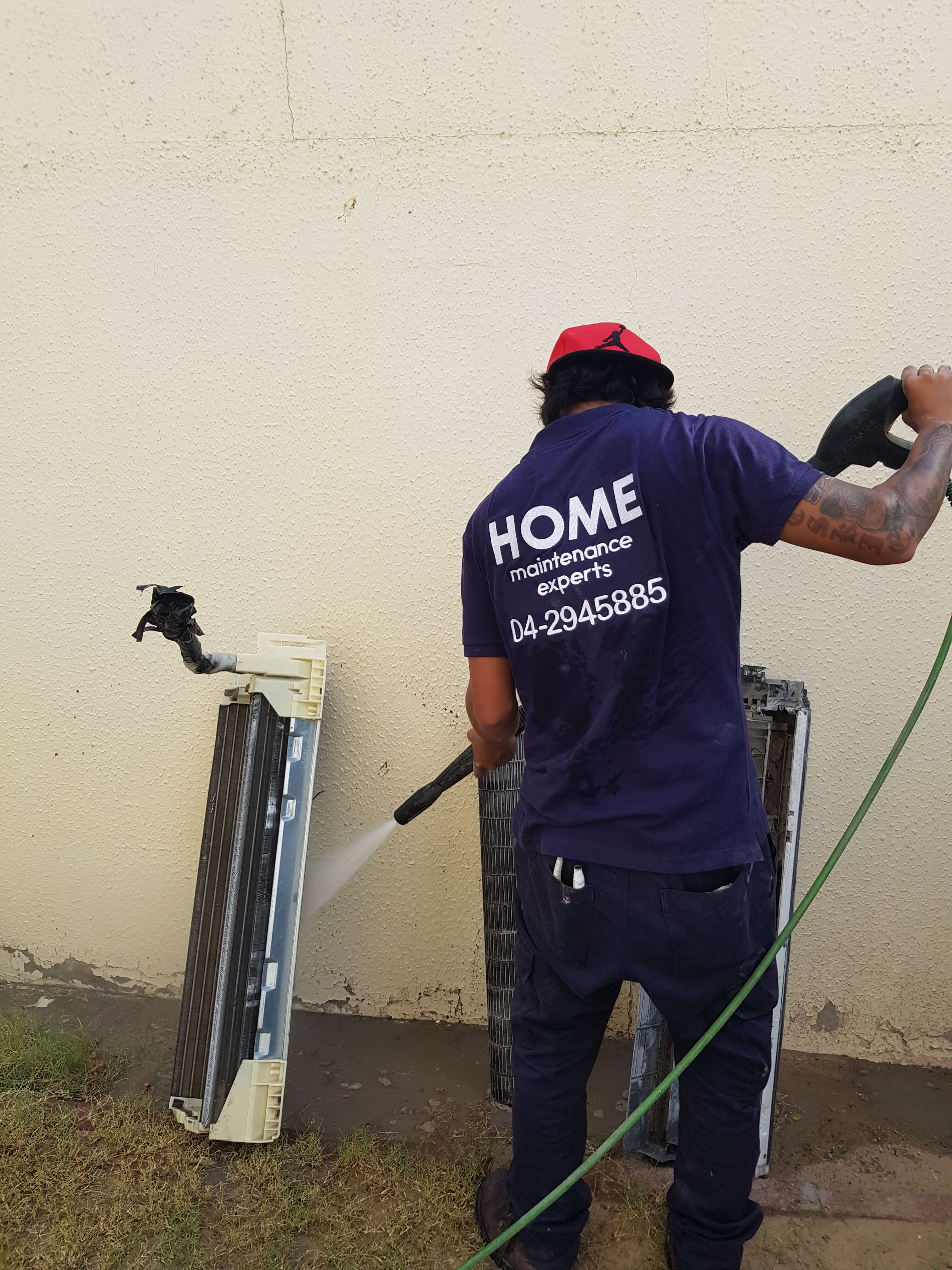
The loosened contamination is flushed away using a low-pressure water rinse, directed carefully to avoid electrical components. The dirty water drains away through the condensate drain line, which is also inspected and cleared during this step.
Step 5 — Antimicrobial treatment
A professional service should include the application of an antimicrobial or antifungal coating to the cleaned coil surface. This inhibits the regrowth of mould and bacteria for an extended period — particularly important in the UAE's humid coastal environment.
Step 6 — Condenser coil cleaning (outdoor unit)
The outdoor unit is inspected and the condenser coil fins are cleaned using a fin comb, brush, and where appropriate a gentle water rinse. Bent fins are carefully straightened to restore airflow. The fan blades and housing are also cleaned.
Step 7 — System restart and performance check
The unit is restarted and the technician checks supply air temperature, return air temperature, and overall system operation to confirm the cleaning has restored performance to the expected level.
Signs Your Coils Need Cleaning Right Now
Do not wait for your annual service if you notice any of the following:
Your AC runs constantly but the room stays warm
Your electricity bill has increased noticeably without a change in usage patterns
You can smell a musty or stale odour when the AC is running
Water is dripping or pooling from the indoor unit
The airflow from the vents feels weak or reduced
You or family members are experiencing more frequent allergy or respiratory symptoms indoors
The outdoor unit sounds louder or more strained than usual
It has been more than 12 months since any AC service was performed
Any one of these symptoms warrants a professional inspection. Multiple symptoms together suggest the coils are significantly fouled and should be addressed immediately before compressor damage occurs.